
Explore Our Homepage
#TikTok Here
Follow us on #Bluesky
UBS shuts down billion-dollar funds as job cuts hit 22-year high and shadow banking cracks widen.
The ghosts of 2008 are back, and this time they’re wearing different masks.
In early November 2025, Swiss banking giant UBS abruptly shuttered two hedge funds managed by its O’Connor unit—a move that sent shockwaves through financial markets and triggered uncomfortable comparisons to the Bear Stearns collapse that foreshadowed the Great Financial Crisis. One fund had heavy exposure to First Brands, an auto parts empire that spectacularly imploded under the weight of an alleged $2.3 billion fraud. But here’s the terrifying part: the second fund had zero direct exposure to First Brands, yet it collapsed anyway.
This isn’t just another bankruptcy. It’s a contagion story—and it’s spreading.
The Redemption Death Spiral
When investors panic and demand their money back, funds must sell assets to raise cash. But most private credit assets can’t be sold quickly. So funds dump whatever they can at fire-sale prices, triggering more panic and more redemptions. This doom loop is exactly how Bear Stearns began its death spiral in mid-2007, more than a year before Lehman Brothers collapsed and took the global economy with it.
The parallels are chilling. In 2007, Bear Stearns closed “high-grade” subprime funds that triggered cascading redemptions. Today, UBS is closing funds caught in the same liquidity vise. Different asset class, identical mechanics.
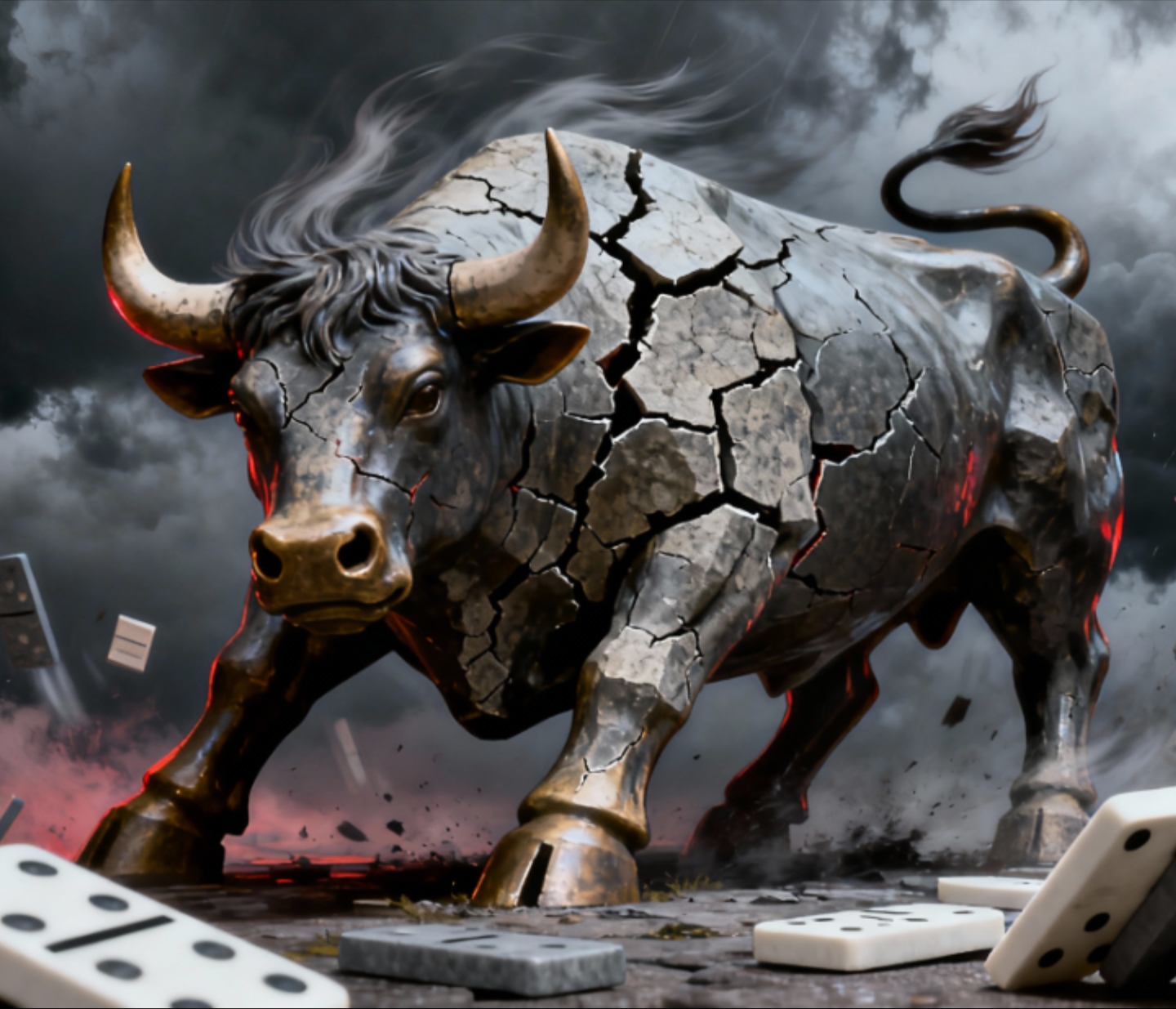
What’s particularly alarming is that UBS initially claimed one of its funds was unrelated to the First Brands collapse. Investors didn’t believe them. They wanted their money out—all of it. This panic spread from one fund to another, proving that in a networked financial system, proximity to failure is often enough to cause collapse. When one domino falls, the others don’t need a direct push; they simply need investors to worry that they might fall next.
This cascading redemption process creates what financial professionals call a “liquidity crunch.” Assets that seemed safe and tradable suddenly become toxic. Bid-ask spreads—the difference between what buyers will pay and what sellers will accept—widen dramatically. In some cases, there are no buyers at all. Fund managers face an impossible choice: sit tight and hope investors stay calm (unlikely), or start selling anything they can to meet redemption requests (and watch their portfolio deteriorate).
The $3 Trillion Shadow Banking Bomb
The real danger isn’t subprime mortgages this time—it’s the $3 trillion private credit market that has ballooned 50% in recent years with minimal regulatory oversight. Fitch Ratings, which previously dismissed private credit as too small to matter, reversed course in October 2025 with a stark warning: shadow banking has developed “bubble-like characteristics” that could trigger a global financial shock.
Major banks now have approximately $4.5 trillion in exposure to private credit entities, according to the International Monetary Fund. Bank lending to shadow banks surged 20% year-over-year as of March 2025. When confidence evaporates in this opaque ecosystem, the damage won’t be contained.
Private credit has exploded because it exists in regulatory gray zones. Traditional banks face stringent capital requirements, deposit insurance obligations, and Federal Reserve oversight. But private credit funds operate with fewer restrictions. They can take on more leverage, hold riskier assets, and operate with less transparency. Investors who might normally demand lower returns from traditional banks have chased private credit for its higher yields—often 8% to 15% annually. The problem: those higher yields exist for a reason. They reflect genuine risk.
The growth of private credit represents a massive migration of capital from regulated banking to unregulated alternatives. This is the definition of shadow banking. When the Federal Reserve tightened monetary policy throughout 2022 and 2023, pushing interest rates higher faster than they’d risen in decades, they inadvertently stressed every corner of the private credit market. Companies that could service debt at 2% suddenly faced refinancing needs at 6%. Investment portfolios that seemed stable deteriorated rapidly. And suddenly, the “contained” subprime situation wasn’t so contained anymore.
The First Brands Fraud: A $9 Billion Cautionary Tale
First Brands, a once-mighty auto parts distributor with $5 billion in annual revenue, filed for bankruptcy in 2025 holding just $12 million in cash against $9.3 billion in debt obligations. Court filings reportedly allege there was fraud involving fabricated invoices, double-pledged collateral, and off-balance-sheet special purpose vehicles that concealed billions in liabilities. Allegations the company reportedly denies.
The scheme allegedly involved inflating invoices by ten times their actual value and factoring the same receivables multiple times to different lenders. The U.S. Attorney for the Southern District of New York is now reportedly conducting a criminal investigation.
What makes the First Brands collapse particularly concerning is its size and visibility. This wasn’t some obscure micro-cap startup. First Brands was a major distributor supplying auto parts to retailers across North America. It had been operating for decades. Yet apparently, auditors, lenders, and board members missed or ignored a multi-billion-dollar fraud. How is that possible?
The answer could reveal systemic vulnerabilities. In a credit boom environment—when money is cheap and investors are desperate for yield—due diligence takes a backseat. Some lenders may stop asking hard questions. They assume that if competitors are lending, it must be safe. They assume that if multiple lenders are already in the deal, the risk has been distributed. What they don’t realize is that everyone is lending to the same underlying fraud. In First Brands’ case, the company allegedly used fabricated receivables according to media reports to borrow from multiple lenders simultaneously. It’s reportedly a classic Ponzi dynamic: pay early creditors with borrowed money from new creditors.
The private credit funds that had exposure to First Brands faced an immediate problem. They had to mark their investments down to zero or close to it. This devastated their returns, triggering the redemptions that forced UBS to shut the funds down.
The Labor Market Is Cracking
October 2025 delivered the worst job-cut numbers in 22 years. Employers announced 153,074 layoffs—a 175% surge from October 2024 and 183% higher than September 2025. Through October, employers announced 1,099,500 job cuts in 2025, a 65% increase from the same period in 2024 and 44% above the entire year of 2024.
A workplace expert at Challenger, Gray & Christmas, reportedly noted that AI adoption, softening consumer spending, rising costs, and post-pandemic corrections are driving belt-tightening and hiring freezes. Those laid off are finding it harder to secure new roles, which could further loosen the labor market.
The sectors bleeding jobs include warehousing (47,878 cuts in October), technology (33,281), and retail (88,664 year-to-date, up 145% from 2024). Cost-cutting accounted for the majority of cuts, while AI has been cited for 48,414 job eliminations in 2025.
The labor market deterioration is no accident. It’s a direct result of economic pressures cascading through the system. Companies that borrowed heavily when interest rates were low now face higher debt service costs. Rising energy prices, supply chain disruptions, and weakening consumer demand squeeze profit margins. Management responds by cutting the single largest controllable cost: headcount.
This creates a vicious cycle. More layoffs mean less consumer spending. Less consumer spending means slower revenue growth for businesses. Slower revenue growth means more pressure to cut costs. And the only way to cut costs significantly is more layoffs. This is the doom loop that preceded the 2008 recession, the 2001 recession, and in fact most recessions.
What’s particularly concerning is that major technology companies—which supposedly have exceptional economics and unlimited growth prospects—are cutting headcount aggressively. If tech companies are laying off, who isn’t? Warehouse workers laid off by Amazon or logistics firms can’t easily transition to other industries. Their skills are specific. When they lose jobs, they lose purchasing power. They delay car purchases, defer medical procedures, cut back on discretionary spending. This ripples through the entire economy.
Subprime Auto Debt: The Canary in the Coal Mine
Subprime car borrowers are drowning. The default rate for subprime auto loans hit nearly 10% in September 2025, with delinquencies climbing to 6.65% in October—up from 6.50% the previous month. While these figures have stabilized slightly from 2024 peaks, they remain well above long-term averages.
Deep subprime auto debt surged 8.7% in 2025, the biggest jump for any credit score band. Over 60% of dealer finance and monoline lender portfolios are now subprime. More than half of all new car leases and over three-quarters of new car loans in Q2 2025 carried monthly payments exceeding $500, while 17% of new car loans topped $1,000 per month.
Repossession volumes are approaching Great Recession levels, according to industry operators. “It’s a target-rich environment right now,” said one repo man in Detroit.
Auto lending has become a direct window into consumer financial stress. People don’t default on car payments lightly because losing a car usually means losing the ability to get to work. Yet defaults are surging. This tells you that borrowers are facing impossible choices: miss a car payment or miss a mortgage payment? Miss a car payment or skip medical care?
The subprime auto situation is directly connected to the First Brands collapse and to the broader private credit crisis. Many of these auto loans are originated by “buy-here, pay-here” dealers and monoline lenders that themselves rely on financing from private credit funds and other non-traditional lenders. When Primal Lend, which financed auto dealers, blew up, dealers lost access to capital. Some couldn’t buy new inventory. Others couldn’t refinance existing dealer loans. The ripple effects cascaded through the entire auto finance ecosystem.
The Counterparty Risk Contagion
When a major institution like UBS shows stress, perceived counterparty risk surges across the entire monetary system. Banks become wary of lending to institutions that might have hidden exposure to troubled entities, causing liquidity to evaporate regardless of Federal Reserve policy.
This is the invisible mechanism that transforms isolated problems into systemic crises. As one financial analyst noted on LinkedIn: “Confidence, not capital, is what keeps the system alive.”
Counterparty risk is perhaps the most dangerous variable in financial systems because it’s largely invisible and impossible to quantify. You can measure a bank’s capital ratio, loan-to-value ratio, or return on assets. But you can’t easily measure whether Bank A might have $5 billion in hidden exposure to the same junk credits that just blew up at Bank B. And if you think Bank A might, you won’t lend to them. And if Bank A can’t borrow, they have liquidity problems. And if they have liquidity problems, maybe they have solvency problems too.
This is why central banks exist. During the 2008 crisis, the Federal Reserve stepped in as the lender of last resort, providing unlimited liquidity to keep the system functioning. The question today is whether the Fed would do the same thing, and whether it would work. The Fed’s balance sheet is already stretched. The political environment is different. The tools available in 2008 might not work in 2025.
Will 2026 Be Like 2008?
Not exactly—but potentially worse in different ways. Central planners have a hair trigger for economic downturns, making a full-scale financial crisis less likely but virtually guaranteeing massive interventions that could dwarf 2020’s response. The current administration has already floated 50-year mortgages and $2,000 stimulus checks.
The base case isn’t a global financial crisis, but rather a garden-variety recession where asset prices decline substantially while the government floods the system with liquidity. This will further distort the economy and erode purchasing power as prices rise faster than incomes.
If history is any guide, the government’s response to economic weakness will be aggressive. Fiscal stimulus packages, monetary accommodation, potentially direct support for failing institutions. The question isn’t whether stimulus happens—it almost certainly will. The question is what happens afterward. Every stimulus eventually ends. Every monetary expansion creates imbalances that must be corrected. Every bailout creates moral hazard and incentivizes future risk-taking.
The real danger isn’t 2026 looking like 2008. It’s 2027 or 2028 looking like 2008, after all the stimulus has worn off and we’re left with an even more distorted economy, more debt, and fewer options.
What It Means for You
If you’re a wage earner working a traditional job, the economic stress described in this article will hit you directly and immediately. Layoffs in your industry or related sectors mean job security becomes precarious—even if you haven’t been affected yet. Reduced hiring means if you lose your job, finding a new one takes longer and may pay less. Rising costs for essentials like food, energy, and housing squeeze your budget at the exact moment your job security is weakening. Credit card debt becomes more expensive as borrowing costs rise. Auto loans that seemed manageable when you took them out become crushing when your hours are cut or you face unemployment. Your emergency fund—if you have one—depletes faster than you can rebuild it.
The private credit crisis and banking stress described above translate into something concrete for you: lenders tighten standards. Your credit card company reduces your available credit. Your auto loan refinancing gets denied. Your mortgage refinance that would have saved you $200 per month gets rejected. Small business loans dry up, which affects family members or friends who own businesses. Your employer’s access to working capital financing gets tighter, which can cascade into wage freezes or delayed bonuses. Pension funds holding private credit investments suffer losses, which threatens retirement security for union workers and public employees.
The most important action you can take is to shore up your own financial position now, while you still have stable income. Build cash reserves—even small amounts matter. Three to six months of essential expenses in a savings account is the minimum target. Reduce high-interest debt aggressively. Pay off credit cards. Don’t take on new auto loans or personal loans unless absolutely necessary. If you have adjustable-rate debt or refinancing options coming up, lock in fixed rates while you still can. Review your employer’s stability—if you work in a sector experiencing major layoffs, start updating your resume and exploring other opportunities before desperation forces you to make worse choices. If you have access to retirement accounts, ensure they’re properly diversified and not overweighted in your employer’s stock.
Most importantly, understand that economic crises create winners and losers based partly on preparation. The families that weather downturns successfully are typically those that saw it coming and adjusted their financial position before the crisis hit. Those caught by surprise often face years of financial recovery. You have time now. Use it.
If you’re a CEO or CFO, now is the time to stress-test your liquidity assumptions. Review where your working capital really comes from and understand your indirect exposures. Ask yourself: would you know where your liquidity goes if everyone asked for their cash back tomorrow?
For businesses with exposure to private credit—whether through lending relationships, customer finance programs, or supplier networks—the time to audit that exposure is now. Many companies don’t know exactly how much leverage exists in their customer base or how directly dependent their suppliers are on private credit funding. Once a crisis starts, that information becomes critical and suddenly very expensive to acquire.
For investors, the warning signs are clear: record job cuts, shadow banking stress, subprime deterioration, and fraud cases emerging in previously obscure corners of finance. These aren’t isolated incidents—they’re interconnected symptoms of an overleveraged system built on unstable foundations.
The traditional advice—diversify your portfolio, maintain an emergency fund, think long-term—remains valid but insufficient. In a genuine credit crisis, correlations break down in ways that surprise even experienced investors. Bonds that were supposed to be safe decline alongside stocks. Alternative investments that were supposed to be uncorrelated become highly correlated when everyone rushes for the exits simultaneously. Cash becomes king, but only if you have it before the crisis hits.
History doesn’t repeat itself exactly, but it’s rhyming loud enough for anyone willing to listen. The cockroaches are emerging, and where there’s one, there are always more.
The only question is whether you’ll be prepared when the lights come on.
Endnotes and Sources
This analysis synthesizes information from the following sources, current as of November 15, 2025:
UBS Hedge Fund Closures:
- LinkedIn post: “UBS shuts down two hedge funds, exposing liquidity risks,” November 7, 2025
- Reddit discussion thread on UBS fund closures and liquidity concerns, November 6, 2025
- Financial analyst commentary on LinkedIn regarding UBS O’Connor fund wind-downs
Shadow Banking and Private Credit:
- WSWS: “Growth of private credit a ‘ticking time bomb,'” November 13, 2025
- Yahoo Finance: “Shadow banking bubble risks global shock, warns credit rating agency,” October 29, 2025
- PCBB: “The Rise & Risks of Shadow Banking,” July 1, 2025
- Capital Economics: “Is private credit a systemic threat to the economy?” October 20, 2025
- Washington Post: “Rise of ‘shadow banking’ brings new financial risks, experts say,” October 18, 2025
First Brands Bankruptcy and Fraud:
- D&O Diary: “First Brands Sues Its Founder for ‘Grievous Misconduct,'” November 9, 2025
- Transport Topics News: “First Brands Creditors Demand Separation of Advisers,” November 12, 2025
- ABC News: “Lawsuit says First Brands founder splurged on exotic cars and celebrity chefs before bankruptcy,” November 4, 2025
- Bloomberg: “First Brands Founder Wins Back Control of Personal Bank Accounts,” November 13, 2025
Labor Market Data:
- Challenger, Gray & Christmas: “October Challenger Report: 153,074 Job Cuts on Cost-Cutting & AI,” November 5, 2025
- Challenger, Gray & Christmas: October 2025 Full Report (PDF)
- CNBC: “Job cuts in October hit highest level for the month in 22 years, Challenger says”
- Reuters: “US layoffs for October surge to two-decade high, Challenger data shows”
- CNN: “Layoff announcements surged last month: The worst October in 22 years”
- JD Supra: “October Layoffs Hit 22-Year High: Legal Considerations for Employers,” November 11, 2025
- The Street: “U.S. worker anxiety expected to rise in the ‘forever layoffs’ era,” November 13, 2025
Subprime Auto Lending:
- CNN: “A significant group of Americans are falling behind on their car payments – an economic warning sign,” October 22, 2025
- Reuters: “Record number of subprime borrowers miss car loan payments in October, data shows,” November 13, 2025
- Equifax: “Auto Lending in 2025: What’s Really Going On? 6 Trends to Know,” November 10, 2025
Economic Analysis:
- George Gammon YouTube video: “Holy Sh*t…Two SUBPRIME Hedge Funds Just Blew Up (Exactly Like Bear Stearns),” November 13, 2025
DISCLAIMER
This article is provided for informational and educational purposes only and does not constitute financial, investment, legal, or professional advice of any kind. The author and publisher are not registered financial advisors, brokers, or investment professionals. The information presented herein represents analysis and commentary on publicly available information and should not be construed as a recommendation to buy, sell, or hold any security or investment, or to pursue any investment strategy or course of action.
Past performance is not indicative of future results. All investments carry risk, including the potential loss of principal. Readers should conduct their own research and due diligence and consult with qualified financial, legal, and tax professionals before making any investment or financial decisions.
The author and publisher expressly disclaim any liability for any loss or damage arising from reliance on information contained in this article. No warranty, express or implied, is made regarding the accuracy, completeness, or timeliness of any information presented herein.
This content represents independent analysis and commentary based on publicly available information from the sources listed above. All facts, figures, and quotations are drawn from the cited publications and reports. The views expressed are subject to change without notice. Market conditions, regulatory environments, and financial situations can shift rapidly and unexpectedly. Information that appears current today may become outdated quickly.
Readers assume all responsibility for decisions made based on information contained in this article. Neither the author nor the publisher shall be liable for any direct or indirect damages, losses, or expenses arising from the use of this information.
Discover more from Your Assignment Editor
Subscribe to get the latest posts sent to your email.

