
•Visit: our YouTube Channel•
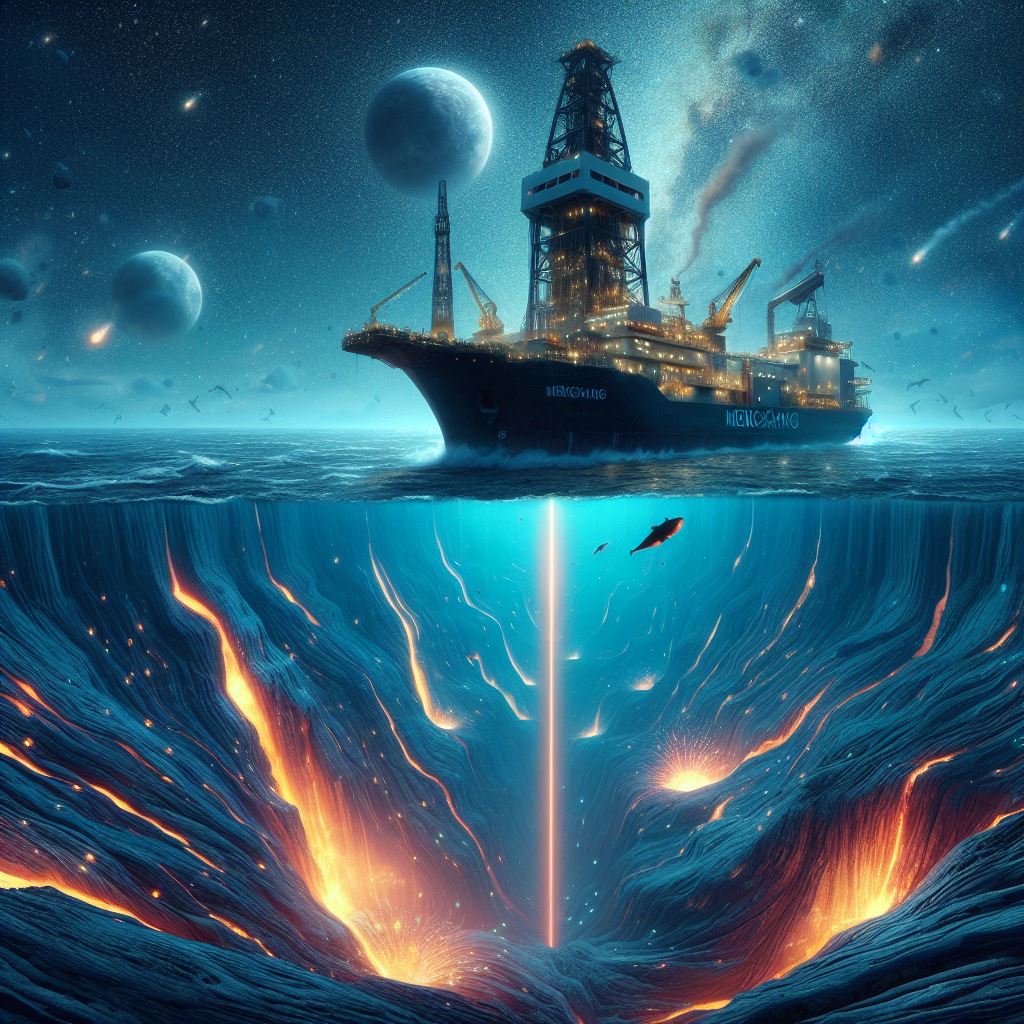
Beneath the cerulean cloak of the Pacific, a leviathan of chrome and ambition carves its path. The Mengxiang, China’s audacious ocean drilling ship, is no mere vessel of conquest. Its aim is not uncharted islands or forgotten treasures, but a descent into the Earth’s primal soul – the mantle, a realm of molten wrath whispered of as the Devil’s own furnace.
Introduction
This isn’t a voyage to charted waters, but a plunge into the planet’s primal scream. Imagine, if you dare, a journey not to the moon, but to the Earth’s fiery heart, to peer into the crucible where continents were forged and oceans birthed. The mantle beckons with secrets older than time, etched in the molten rock: whispers of ancient cataclysms, the birth pangs of life, and the symphony of tectonic plates that choreograph earthquakes and volcanic eruptions.
But this knowledge, like a forbidden fruit, hangs tantalizingly just beyond reach, guarded by perils as old as the Earth itself. In this story we will explore the scientific allure, the human cost, and the ethical maelstrom surrounding the Mengxiang’s perilous descent to the Devil’s mantle.
The Scientific Allure
For scientists, the mantle is a forbidden library, its pages filled with the Earth’s autobiography. Its geotherm, a furnace of unimaginable power, promises energy beyond fossil fuels. Understanding its composition could unlock mysteries of climate change, mineral deposits, and perhaps, even the possibility of life in unexpected forms.
The mantle accounts for about 84% of the Earth’s volume, and yet, we know very little about it. The deepest we have ever drilled is about 12 kilometers, barely scratching the surface of the crust, which is about 35 kilometers thick on average. The mantle lies beneath the crust, extending to about 2,900 kilometers deep, where it meets the core.
To reach the mantle, the Mengxiang has to drill through the crust, which is composed of hard, brittle rock. The crust is also uneven, with thicker and thinner regions, and varying degrees of seismic activity. The Mengxiang’s target is a thin spot in the crust, located in the Pacific Ocean, where the crust is only about 6 kilometers thick.
The Mengxiang is equipped with a state-of-the-art drilling system, capable of penetrating the crust and reaching the mantle. The drill bit is made of diamond, the hardest material known to man, and can withstand temperatures of up to 250°C and pressures of up to 100 megapascals. The drill pipe is also reinforced with steel and titanium, and can transmit data and samples from the drill bit to the ship.
The Mengxiang’s mission is to collect rock samples from the mantle, and analyze them for their chemical and physical properties. The samples could reveal clues about the Earth’s history, such as how the continents formed, how the oceans originated, and how the climate changed over time. The samples could also contain traces of organic molecules, or even microorganisms, that could shed light on the origin and evolution of life.
Another goal of the Mengxiang’s project is to harness the geothermal energy of the mantle. The mantle is a reservoir of heat, generated by the decay of radioactive elements and the friction of tectonic plates. The temperature of the mantle ranges from about 500°C at the top to about 4,000°C at the bottom. This heat could be used to generate electricity, by pumping water into the mantle and using the steam to drive turbines. This could provide a clean, renewable, and abundant source of energy, that could replace fossil fuels and reduce greenhouse gas emissions.
The Human Cost
The path to the mantle is a gauntlet of nightmares. Kilometers of granite, the Earth’s armored shell, stand ready to bludgeon the drill, its teeth chattering against the unyielding rock. Pressure, a crushing leviathan, intensifies with each meter of descent, threatening to implode the steel hull like a tin can. Temperatures soar, scorching breath that could melt the very tools designed to conquer it. And in the inky depths, where sunlight dares not tread, the whispers of something more sinister begin to stir.
The ocean, once a familiar friend, becomes a suffocating prison. Currents twist into malevolent eddies, swallowing equipment and light in their churning depths. Unnatural silence descends, broken only by the rhythmic clang of the drill, a hammer on the anvil of the Earth. Strange bioluminescent eyes flicker in the gloom, watching from the abyss. And then, the tremors begin. The Earth, stirred from its slumber, groans and shudders, a beast awakened by the Mengxiang’s audacious intrusion.
The Mengxiang’s project is not for the faint of heart. It requires courage, skill, and perseverance, as well as a willingness to face the unknown and the unpredictable. The crew of the Mengxiang consists of about 200 people, including scientists, engineers, technicians, and support staff. They work in shifts, 24 hours a day, 7 days a week, for months at a time. They live in cramped quarters, with limited amenities and entertainment. They endure physical and mental stress, as well as isolation and boredom.
The crew also faces constant danger, from both natural and man-made hazards. The drill could break, jam, or overheat, causing delays, damage, or even explosions. The ship could encounter storms, waves, or pirates, threatening its stability, security, or safety. The ocean could unleash its fury, in the form of sharks, squids, or other creatures, that could attack or damage the ship or the drill. The Earth could retaliate, in the form of earthquakes, volcanic eruptions, or landslides, that could disrupt or destroy the project.
The Mengxiang’s project is not only a scientific expedition, but a human adventure, a testament to the insatiable human thirst for knowledge, even when it teeters on the precipice of oblivion. It’s a story of ambition and hubris, of caution and curiosity, a dance with the Devil’s mantle that could forever change our understanding of our planet and ourselves.
The Ethical Maelstrom
But it’s not just the Earth that shudders. Back on land, a different storm brews. Critics question the wisdom of this Faustian bargain. Is the pursuit of knowledge worth the potential disruption of the Earth’s balance? Could unleashing the secrets of the mantle trigger volcanic eruptions, earthquakes, or even something more…unforeseen? Environmentalists point to the ecological cost, the disturbance of deep-sea ecosystems, and the potential release of pollutants trapped within the Earth’s crust.
The Mengxiang’s project is not without controversy. It raises ethical, social, and environmental issues, that challenge our values and responsibilities. Some of these issues are:
- The risk of triggering natural disasters. Drilling into the mantle could destabilize the crust, causing cracks, faults, or fissures, that could lead to seismic or volcanic activity. This could endanger the lives and livelihoods of millions of people, especially those living near the coast or on islands. It could also damage infrastructure, such as buildings, roads, or bridges, and disrupt services, such as water, electricity, or communication. It could also affect the climate, by releasing greenhouse gases or ash into the atmosphere, altering the temperature, precipitation, or wind patterns.
- The impact on the marine environment. Drilling into the mantle could disturb the delicate balance of the ocean, affecting its chemistry, biology, and physics. It could alter the salinity, acidity, or temperature of the water, affecting the growth, reproduction, or survival of marine organisms. It could also introduce foreign substances, such as metals, chemicals, or microbes, into the ocean, causing pollution, toxicity, or infection. It could also disrupt the food chain, by affecting the availability, distribution, or diversity of marine resources.
- The ownership and access of the mantle’s resources. Drilling into the mantle could open a new frontier of exploration, exploitation, and competition, for the mantle’s resources, such as minerals, metals, or energy. It could create conflicts, disputes, or tensions, among different countries, regions, or groups, over the rights, claims, or interests, of the mantle’s resources. It could also create inequalities, injustices, or abuses, in the distribution, allocation, or utilization, of the mantle’s resources, favoring some over others, or excluding some altogether.
The Mengxiang Expedition: A Revolutionary Hunt for Flammable Ice
China’s quest for energy independence has led to the birth of the Mengxiang expedition. This groundbreaking venture involves the use of China’s first independently developed drilling vessel, aptly named “Mengxiang” (Dream), which is equipped to reach unprecedented depths.
The Mengxiang Drillship
The Mengxiang drillship is a marvel of modern engineering. With a weight of around 33,000 tonnes and dimensions of 179.8 meters in length and 32.8 meters in width, it is a formidable presence in the ocean. The vessel is equipped with leading ocean drilling capabilities and is set to focus on extracting a distinctive resource known as “flammable ice” or methane hydrates.
Flammable Ice: The Future of Energy?
Flammable ice, also known as methane hydrates, are ice-like compounds of water molecules containing trapped natural gas, primarily methane. These hydrates are stable at specific temperature and pressure conditions found in deep-sea sediments and permafrost regions. The South China Sea alone is estimated to contain roughly 80 billion tonnes of this potential energy source.
The Hunt for Flammable Ice
The Mengxiang vessel is designed to scan the South China Sea for methane hydrate sources. Its sprawling laboratory will assist in researching them. The ship is essential for helping China explore and use natural gas hydrates, making China more independent in getting energy and improving its ability to drill under the ocean.
Environmental Considerations
While methane hydrates have the potential to become a commercially viable energy source, they are not considered environmentally friendly. Concerns arise over the environmental impact of mining gas hydrates, such as the potential release of greenhouse gasses and threats to marine life. Balancing energy needs with environmental stewardship remains critical in pursuing gas hydrate mining.
The Mengxiang expedition represents a significant step towards energy independence for China. As the world’s largest importer of oil and gas, China is strengthening its capabilities in maritime activities. The hunt for flammable ice is not just a dream but soon to be a reality that could revolutionize the future of energy.
Mengxiang is not a simple matter of curiosity or discovery. It is a complex and consequential endeavor, that involves moral and political choices, that affect not only the present, but also the future. It is a challenge that demands careful and critical thinking, as well as dialogue and collaboration, among different stakeholders, such as scientists, policymakers, citizens, and activists.
Conclusion
The Mengxiang’s perilous descent to the Devil’s mantle is a groundbreaking and controversial project, that could reveal the Earth’s secrets and reshape the world’s future. It is a project that challenges the limits of science and technology, as well as the ethics and politics of society. It is a journey that confronts us with the wonders and dangers of the deep and the surface, the secrets of our planet and ourselves.
Sources:
- China’s First Ocean Research Drilling Vessel, Mengxiang, Ready For Sea Trials
- China unveils drillship to harvest ‘flammable ice’ from oceanic depths
- Flammable ice to be dug in South China Sea
- China’s 1st homegrown ocean drillship starts trial voyage
- China’s first homegrown ocean drillship starts trial voyage

Visit: our YouTube Channel
https://www.yourassignmenteditor.com
Discover more from Your Assignment Editor
Subscribe to get the latest posts sent to your email.

